
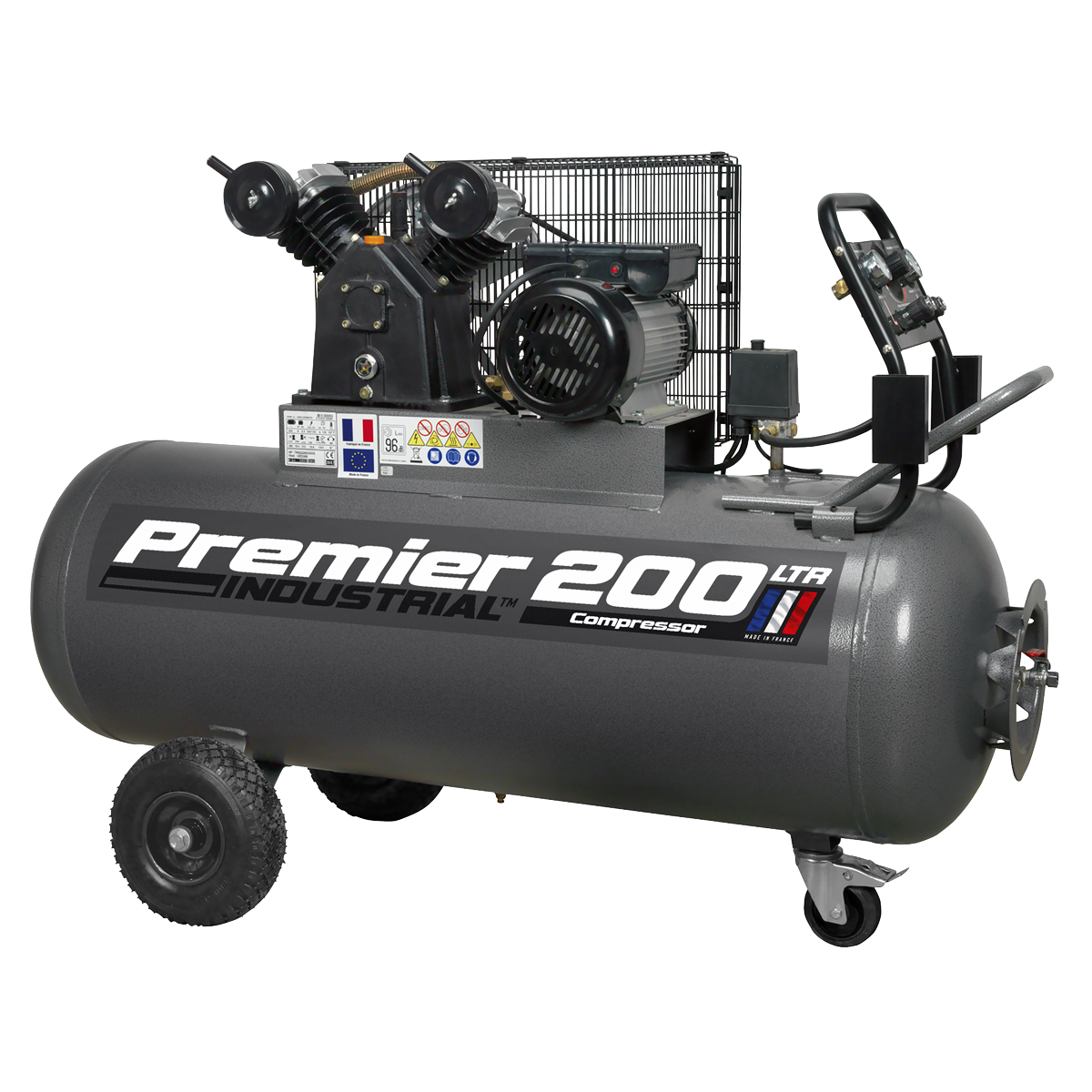
The correct workshop compressor is determined by the air tools and processes it must run, not simply by tank size or motor horsepower. A large receiver cannot compensate for a pump that produces too little air, and a high peak pressure does not tell you how much usable airflow is available while the tool is working.
Start with actual air demand
List every pneumatic tool or process you expect to operate: impact wrenches, ratchets, sanders, grinders, spray guns, tire equipment, blow guns, plasma equipment that requires compressed air, and any air-operated workshop machinery. For each one, find the manufacturer’s airflow requirement at its stated operating pressure.
Pay particular attention to high-consumption tools such as sanders, grinders, and spray equipment. They can demand air continuously, while an impact wrench may consume air in shorter bursts.
Compare FAD or delivered airflow, not only displacement
Compressor specifications can use different airflow terms. Free Air Delivery (FAD), SCFM, CFM, piston displacement, and theoretical displacement are not interchangeable. For tool sizing, use the manufacturer’s delivered-air figure at a relevant pressure whenever it is available. The compressor should provide enough usable airflow for the intended duty with reasonable reserve.
Allow for simultaneous use and future expansion
A one-person garage running one tool at a time has a different requirement from a workshop where two technicians can use air simultaneously. Add the likely concurrent demands rather than simply adding every tool in the building. Then allow headroom for leaks, pressure drop, and future equipment so the compressor is not operating at its limit throughout the day.
Understand duty cycle
Duty cycle describes how long a compressor is designed to run within a given period. A machine that is adequate for intermittent wheel changes may be unsuitable for continuous sanding or spraying even when the headline airflow looks similar. Check the manufacturer’s duty-cycle and ambient-temperature conditions rather than assuming continuous operation.
Receiver size: useful, but not the primary sizing figure
The receiver stores compressed air and reduces rapid cycling. A larger tank can provide a useful buffer for short bursts and may allow longer intervals between starts. It does not increase the pump’s sustained output. If a tool consumes more air than the pump can replace, tank pressure will eventually fall regardless of receiver size.
Direct drive or belt drive
- Direct drive: compact and often convenient for lighter or mobile use.
- Belt drive: common in larger workshop compressors and can allow lower pump speed, easier component service, and higher sustained output depending on design.
Judge the complete compressor by delivered air, duty rating, noise, service requirements, and build rather than drive type alone.
Oil-lubricated or oil-free
Oil-lubricated compressors are common in general mechanical workshops and require oil checks and maintenance. Oil-free compressors reduce the risk of lubricating oil entering the air stream and can be useful where cleaner air or lower maintenance is a priority. Neither choice automatically produces breathing-quality or paint-quality air; filtration and treatment requirements are separate.
Electrical supply is critical
Check voltage, phase, full-load current, starting current, plug or hard-wiring requirements, and the manufacturer’s recommended circuit protection. Larger compressors can require a dedicated circuit or three-phase supply. Do not buy a compressor on the assumption that an adapter or extension lead will solve an incompatible electrical requirement.
Noise and installation location
Compressor noise affects technician comfort and where the machine can be installed. Compare published sound figures only when the measurement method is comparable. A silenced compressor can be valuable in smaller workshops, but it still needs ventilation and service access. Do not enclose a standard compressor in an unventilated cabinet just to reduce noise.
Plan the air system, not only the compressor
Pressure drop, water, contamination, and undersized piping can make a correctly sized compressor perform poorly at the tool. Consider line diameter, hose length, regulator flow capacity, drains, water separators, filters, dryers, and point-of-use treatment. Spray finishing and instrumentation can require cleaner and drier air than general impact tools.
Moisture management
Compressing air produces condensate. Receivers and filters need appropriate draining, and some workshops need refrigerated or desiccant drying depending on the process. Follow local requirements for condensate handling and the compressor manufacturer’s maintenance procedure.
Space, ventilation, and freight
Measure the installed footprint with room for airflow, belt guards, drains, filters, electrical access, and maintenance. Large receivers can be heavy freight items; check packaged dimensions, delivery access, and unloading arrangements before ordering.
Workshop compressor checklist
- Delivered airflow meets the real tool demand at the required pressure.
- Duty cycle suits the longest-running process.
- Receiver size suits the usage pattern without being mistaken for pump capacity.
- Electrical supply matches voltage, phase, and starting requirements.
- Noise is acceptable for the intended location.
- Filtration, drying, regulators, hoses, and piping are sized correctly.
- Ventilation and maintenance access are provided.
- Future air demand has been considered.
- Freight and installation requirements are understood.
Share:
Buyer’s Guide: How to Choose a Garage Jack
Buyer’s Guide: MIG vs ARC Welding for Workshop Use