
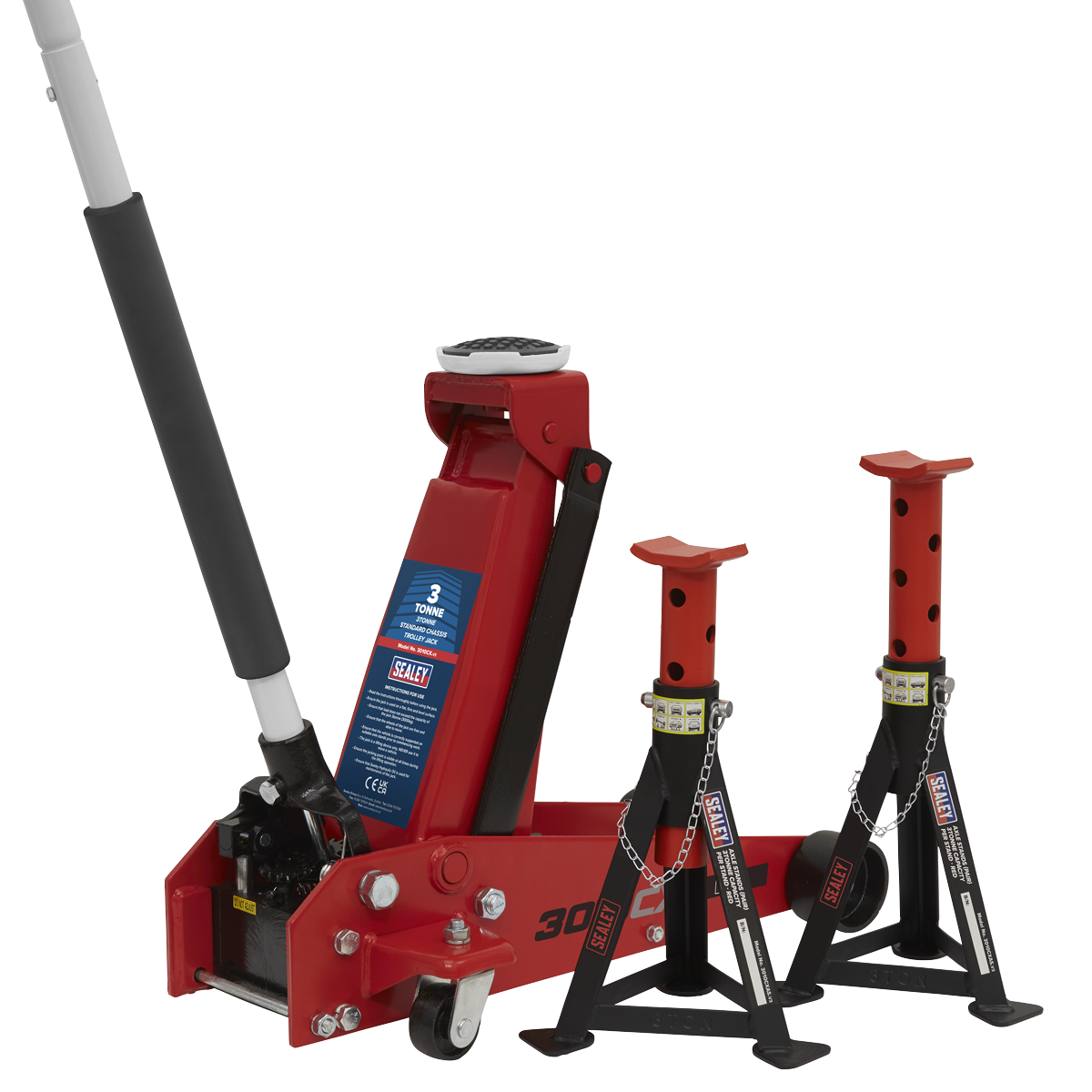
A garage jack should be selected around the vehicles you actually service, the lift points you need to reach, and the floor it will operate on. Rated capacity is important, but it is only one part of a safe and useful setup. Minimum height, lift range, chassis length, saddle design, stability, and the way the vehicle will be supported after lifting all matter.
Start with the vehicle and the approved lift points
Check the vehicle manufacturer’s lifting information before choosing or positioning a jack. The jack must be suitable for the load applied at the lifting point and must never be used beyond its rated capacity. Do not assume that a jack is suitable simply because its capacity is greater than the vehicle’s total curb weight; actual loading at a lifting point depends on vehicle layout and the lifting procedure.
If your workshop services a wide range of vehicles, choose equipment with enough capacity and lift range for the heaviest intended applications rather than sizing around the lightest vehicle in the shop.
Minimum saddle height can be the deciding factor
Low-profile cars, vehicles with aerodynamic undertrays, lowered suspension, and some EVs can have limited access to approved lifting points. Compare the jack’s fully lowered saddle height with the real clearance under the vehicle. A jack that cannot reach the lift point without driving onto blocks or improvising is the wrong tool for that application.
Check maximum lift height and usable lift range
Maximum height determines whether you can raise the vehicle far enough to place suitable axle stands, remove a wheel comfortably, or achieve the clearance required for the job. Consider the complete working range from the fully lowered saddle to the highest safe position rather than looking only at maximum height.
Reach and chassis length matter
Some lift points sit well inboard from the sill or bumper line. A longer chassis can help reach central crossmembers or differential-area lifting points where approved by the vehicle manufacturer. However, a longer jack also requires more floor space to maneuver. Measure the working area between benches, lift posts, walls, tires, and other equipment.
Saddle shape and contact area
The saddle should make stable contact with the approved lift point without slipping or damaging the vehicle. Some applications require a compatible rubber pad, lifting adapter, pinch-weld adapter, or manufacturer-specific accessory. Do not improvise with loose blocks or unstable spacers.
Stability, wheels, and workshop floor
A trolley jack needs a hard, level, load-bearing surface. Soft asphalt, gravel, damaged concrete, ramps, or sloping floors can allow the jack or vehicle to move unexpectedly. The jack’s wheels must be able to roll slightly as the lifting geometry changes. Blocking the jack from moving when it needs to can introduce side loading.
For regular workshop use, compare chassis width, wheel size, caster quality, handle control, and the overall footprint. A wider, heavier jack may be less convenient to carry but can feel more controlled in repeated professional use.
Lift speed versus control
Quick-lift or rapid-pump systems reduce the number of handle strokes needed to bring the saddle to the vehicle. They save time but do not replace careful positioning. Lowering control is equally important: the release mechanism should allow the vehicle to descend smoothly rather than dropping abruptly.
A jack lifts the vehicle; it does not replace supports
Never work under a vehicle supported only by a hydraulic jack. After lifting, support the vehicle with appropriately rated stands or another approved support system positioned at suitable support points. Chock wheels as required, apply the parking brake when appropriate, and follow the vehicle and equipment manufacturers’ procedures.
Think about daily workshop use
- Occasional maintenance: portability and storage may matter more than rapid lift features.
- High-frequency workshop use: prioritize robust casters, controlled lowering, serviceable hydraulics, handle ergonomics, and replacement-part support.
- Low vehicles: minimum saddle height and long reach are often critical.
- Vans and heavier vehicles: capacity, lift height, chassis stability, and floor loading become more important.
Delivery weight and storage
Heavy-duty trolley jacks can be substantial freight items. Check packaged dimensions and weight before ordering, especially if delivery involves steps, restricted access, or no loading equipment. Also plan where the jack will park so it does not obstruct vehicle movement or emergency routes.
Garage jack selection checklist
- Rated capacity covers every intended application.
- Minimum saddle height fits under the vehicle.
- Maximum lift height provides the required working clearance.
- Chassis reach can access approved lift points.
- Saddle and any adapters suit the lifting point.
- Floor is hard, level, and capable of carrying the load.
- Axle stands or another approved support system are available.
- Jack dimensions fit the workshop aisle and storage area.
- Delivery weight and unloading requirements are understood.
Share:
Buyer’s Guide: How to Choose a Tool Chest
Buyer’s Guide: Choosing an Air Compressor for a Workshop