
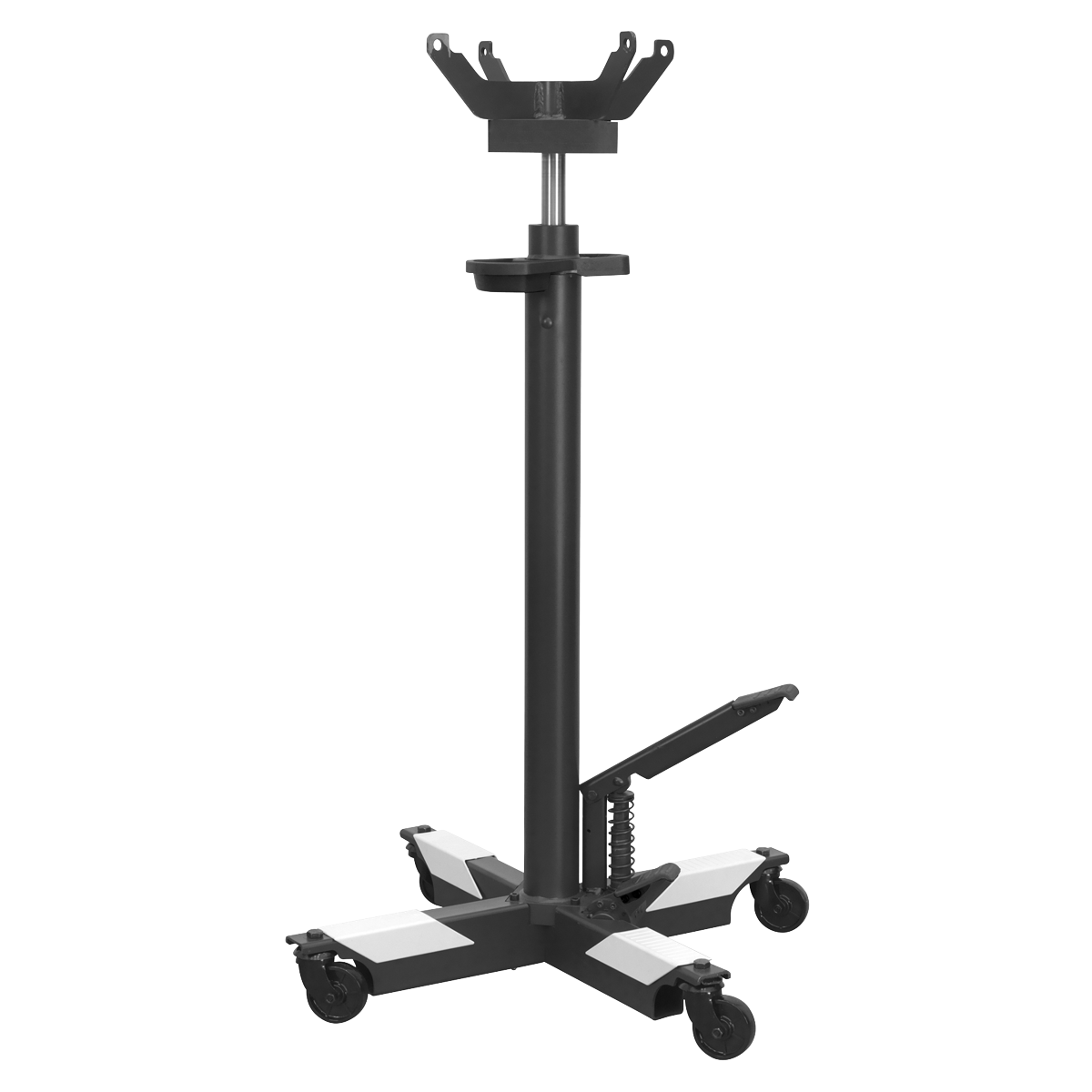
A transmission jack is designed to support and position transmissions, gearboxes, transaxles, and related assemblies during removal and installation. The right jack must fit the workshop’s lifting setup and safely handle the assembly’s weight, shape, center of gravity, and working height.
Choose the jack style for the way the vehicle is raised
Vertical transmission jacks are commonly used beneath vehicles already raised on a two-post or four-post lift. Low-level or floor-style transmission jacks are intended for work where the vehicle is supported closer to the ground. A jack that has the right capacity but the wrong working-height range can be unusable.
Know the assembly weight
Confirm the weight of the transmission or drivetrain assembly being removed. Accessories, transfer cases, motors, differentials, and attached components can significantly change the total. The jack’s rated capacity must exceed the actual supported load, and the load must remain within the manufacturer’s stated conditions throughout the movement.
Do not estimate the weight of an unfamiliar assembly when service information is available. For heavy EV drivetrain components or unusual commercial-vehicle assemblies, use equipment specifically rated and configured for the task.
Minimum and maximum working height
Measure the distance from the workshop floor to the assembly when the vehicle is at a practical service height. Compare that with the jack’s minimum saddle position and maximum lift. Allow enough travel to lower the assembly clear of the vehicle and enough reserve to align it during installation.
Single-stage versus telescopic designs
Telescopic vertical jacks can provide a broader height range without an excessively tall collapsed height. This can be useful under vehicle lifts where the working height varies. Compare the full extension range, stability, pump location, and control layout rather than choosing only by maximum height.
Saddle size and tilt adjustment
Transmissions rarely present a flat, centered load. A broad adjustable saddle or cradle helps support irregular housings. Fore-aft and side-to-side tilt can be valuable when aligning bellhousings, mounts, or subassemblies. Check the adjustment range and how the tilt controls behave under load.
Securing chains, straps, and adapters
The assembly must be secured to the saddle using the system specified by the jack manufacturer. Chains or straps reduce the risk of the load rolling or sliding as the jack moves. Check whether the required securing equipment is included and whether model-specific adapters are available for unusual components.
Footprint, casters, and stability
A wide chassis can improve stability but requires more floor space around lift posts, toolboxes, and vehicle wheels. Measure the base dimensions and caster arrangement. Casters should roll freely on a hard, level floor so the jack can be positioned without side-loading the supported assembly.
Pedal and control position
During removal or installation, the technician may need both hands to stabilize and guide the assembly. Foot-operated pumping can be useful, while a well-positioned lowering control allows small height corrections. The release should permit controlled descent rather than abrupt lowering.
Workshop floor and lift compatibility
Confirm that the floor is level, smooth, and capable of supporting the combined point loads from the vehicle lift, vehicle, jack, and drivetrain assembly. Verify clearance around lift arms and posts. A transmission jack must not be used as a substitute for a vehicle support system.
Removal planning matters as much as jack capacity
Before loosening mounts, plan the route by which the assembly will leave the vehicle. Check exhausts, crossmembers, driveshafts, wiring, cooling lines, subframes, and the jack’s base. An assembly can change its center of gravity suddenly when mounts or attached components are removed.
Freight, assembly, and storage
Heavy transmission jacks can arrive by freight and may require assembly before use. Check packaged weight, receiving access, required tools, hydraulic setup, and inspection procedure. Store the jack fully lowered where practical and protect the hydraulic ram and saddle from impact and contamination.
Transmission jack checklist
- Capacity exceeds the complete supported assembly weight.
- Minimum and maximum height suit the vehicle-lift setup.
- Saddle dimensions fit the transmission or adapter.
- Tilt adjustment provides the alignment range required.
- Approved chains, straps, or securing hardware are included or available.
- Base footprint fits between lift posts and obstacles.
- Casters and floor condition allow controlled movement.
- Controls can be operated while the load is being guided.
- Freight weight and unloading arrangements are understood.
Share:
Buyer’s Guide: MIG vs ARC Welding for Workshop Use
Buyer’s Guide: Workshop Lighting